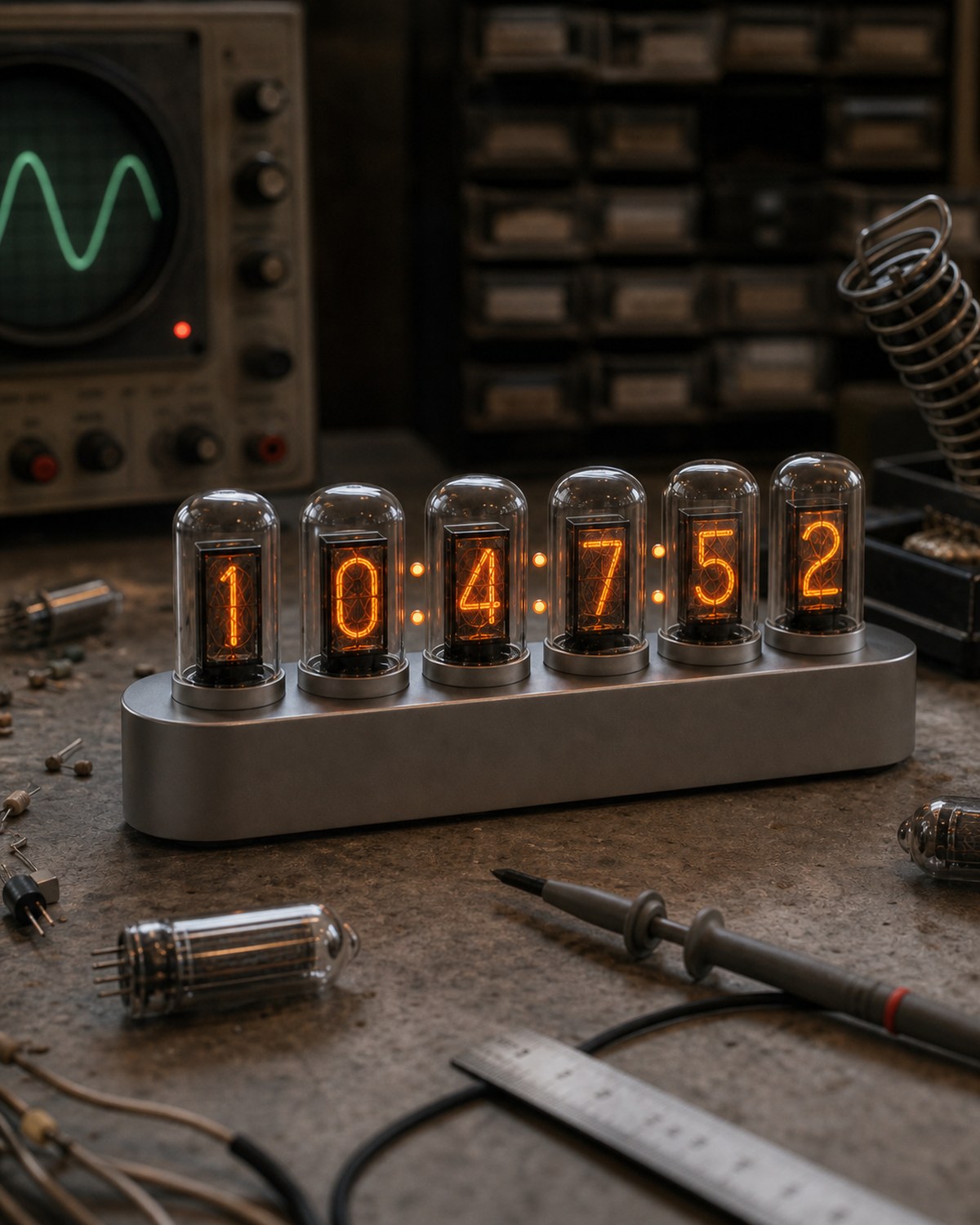
Vintage Nixie tubes are finite industrial leftovers. That scarcity is part of the appeal, but it also means the market rewards vague listings, mismatched lots, and optimistic descriptions. A good buyer behaves less like a shopper and more like a conservator.
This guide is for people buying loose tubes, replacement sets, or kit parts. If you want a finished clock, start with the maker guide; the risk profile is different.
The inspection checklist.
Every digit lit
Ask for powered photos of 0 through 9 on every tube. A single glamour shot of one digit tells you almost nothing.
Cathode poisoning
Look for dim sections, blotchy glow, or digits that only fully light after warm-up. Mild poisoning can improve with cycling; severe poisoning should be priced accordingly.
Glass condition
Clouding, internal deposits, cracks around pins, and loose bases are not character. They are ownership risk.
Matching lot
For a visible six-tube clock, mismatched height, tint, and digit geometry will bother you forever. Buy extras from the same lot when possible.
Socket and pinout
IN-14, IN-12, IN-18, ZM1040, and Western types do not share a universal socket story. Verify the clock or PCB before buying replacements.

NOS, pulled, tested: what the words actually mean.
“NOS” should mean new old stock: manufactured decades ago, never installed, ideally still in original packaging. In listings it sometimes means “old and looks unused.” Treat the claim as a starting point, not proof.
“Pulled” means the tube came out of equipment or another clock. That is not automatically bad. Many pulled tubes have decades of life left if they were driven gently. What matters is test evidence: all digits, comparable brightness, no visible physical damage, and a seller willing to answer specific questions.
“Tested” is useful only when the test is described. Ask what voltage/current was used, whether every cathode was lit, and whether the seller will identify weak digits in writing. A vague “tested working” line is not enough for an expensive matched set.
Questions to send before buying.
- Can you provide photos of every digit lit on every tube?
- Are the tubes from the same production lot or mixed stock?
- Do you see any dim cathodes, missing segments, or delayed glow?
- Are any pins bent, cut, oxidized, or loose in the glass base?
- What is your return policy if a digit is weak on arrival?
Questions, answered.
+Is NOS always better than pulled Nixie tubes?
Not automatically. True NOS with matching packaging is valuable, but a gently used pulled tube with clean digits and honest test photos can be a better buy than a poorly stored NOS tube with cloudy glass or weak cathodes.
+Which vintage tube type should a first collector learn first?
Start with common types such as IN-14 or IN-12 before moving into larger, more expensive tubes like IN-18 or rare Western references. The common types teach the same inspection discipline with less financial risk.
+What is the biggest red flag in a listing?
A listing with no powered-on digit photographs. You need to see every cathode lit, not just the tube sitting unpowered on a table.
Read next
If loose tubes feel too risky, compare finished makers in our Nixie clock maker guide. For display technology context, read the real Nixie vs. IPS teardown.