nixieclock.art

Technology

Nixie, VFD, IPS — what actually matters.

Four display technologies, four trade-offs. A short field guide for anyone shopping in 2026 — grounded in how these things look in a real room, not spec sheets.

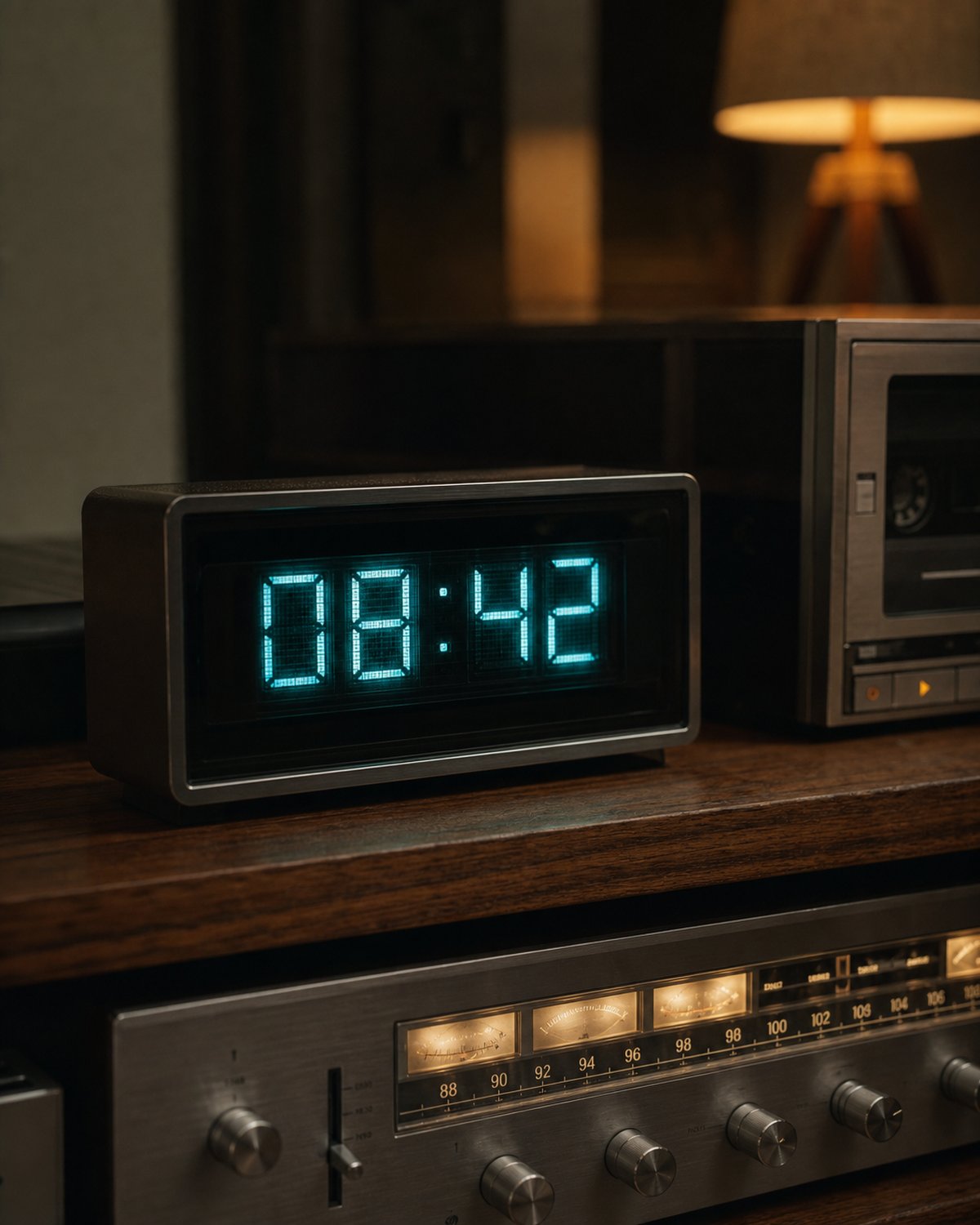
Nixie tube clock adjacent to a blue-green VFD clock on audio shelf.
Nixie, VFD, and IPS now sit beside each other in the same desk culture, but they come from different technical histories.

New reference expansion

Real Nixie anatomy

The useful way to explain Nixie technology is not to romanticize it. Treat it as a small sealed indicator tube, then ask what the clock maker has done to make that old display practical on a modern desk.

Cold-cathode tube

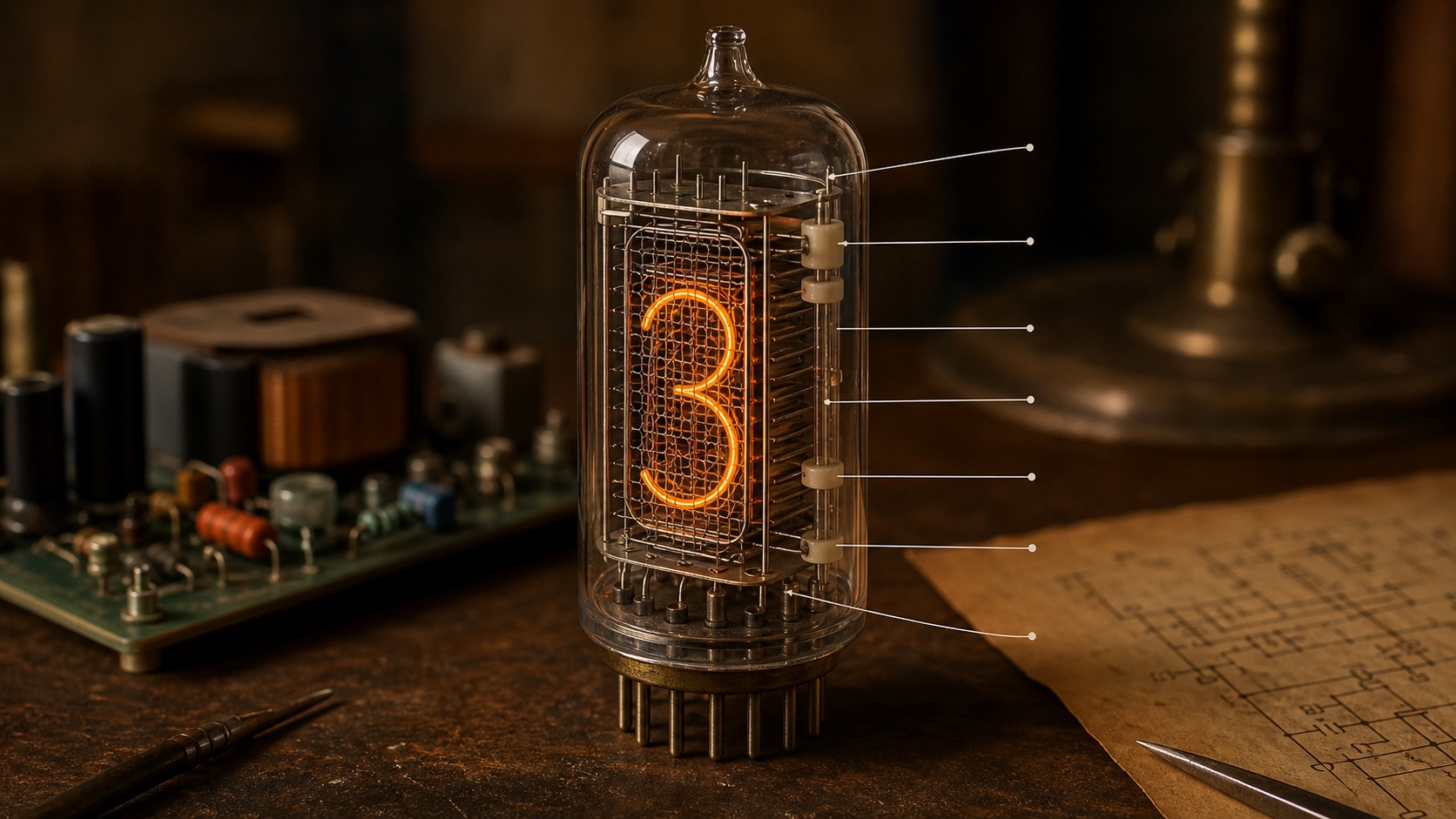
A real Nixie is a gas-discharge indicator. Each numeral is a shaped metal cathode inside a sealed glass envelope, and the selected cathode glows when driven at high voltage.

Stacked numerals

The digits are not printed on one flat plane. They sit at different depths, which is why macro photos reveal a real 3D object rather than a single screen image.

Cathode poisoning

If the same digits run for too long, unused cathodes can develop deposits or uneven glow. Good clocks rotate digits or use anti-poisoning routines.

Driver electronics

A finished clock is part display artifact and part high-voltage electronics project. Case design, insulation, firmware, power supply, and serviceability matter.

Original generated reference image showing a Nixie tube with internal cathode stack, anode mesh, supports, and orange glow
Original nixieclock.art generated reference image: a readable visual summary of the cathode stack, anode mesh, glass envelope, ceramic spacers, and orange neon glow.

The original

Nixie Tubes

Warm orange-pink glow produced by gas discharge. Iconic numerals, high voltage, finite supply. Every tube is a small sculpture.

The sibling

VFD

Vacuum fluorescent displays — bright blue-green, high contrast, excellent readability. Cheaper and more available than Nixie.

The modern answer

IPS “Digital Nixie”

A miniature IPS screen inside a tube-shaped envelope. Pixel-accurate dial simulation, safer, endlessly customizable, and what most 2026 buyers actually want.

The flexible

LED Matrix

Efficient, inexpensive, and very reconfigurable. Loses the analog warmth but wins on cost and novelty.

Historical arc

From orange industrial numerals to blue-green consumer displays to modern customizable tubes.

1950s-1970s

Nixie becomes the instrument-display icon.

Haydu Brothers and Burroughs-era cold-cathode displays gave counters, meters, calculators, and lab instruments legible orange numerals before LEDs became cheap enough to replace them.

1960s-1980s

VFD pushes the category into consumer electronics.

Vacuum fluorescent displays brought a lower-voltage, blue-green phosphor glow to calculators, hi-fi receivers, appliances, dashboards, and point-of-sale machines.

2000s-2010s

Collectors turn obsolete parts into desk objects.

Surplus Nixie tubes and VFD modules became the raw material for hobbyist clocks, kit builders, small makers, and modern tube revival projects.

2020s

IPS becomes the mainstream modern branch.

IPS Nixie-style clocks simulate tube depth with miniature screens, but win the practical ownership argument: custom faces, low voltage, better supply continuity, and easier replacement.

Community checklist

What Reddit and collector forums keep asking first.

The recurring concerns are not vague nostalgia. They are concrete ownership questions: what display is actually inside, how it is powered, how it ages, and whether replacement parts will exist.

Collector concern

Real vs simulated: collectors care whether a listing is cold-cathode Nixie, VFD, Numitron, LED, edge-lit acrylic, or IPS.

Editorial take

Our view: the problem is not simulation itself. IPS and LED clocks can be excellent desk objects, but the listing must name the display honestly so buyers do not pay real-tube prices for a screen effect.

Collector concern

High voltage: real Nixie clocks are normal consumer objects when enclosed well, but DIY boards and open cases demand respect.

Editorial take

Our view: finished enclosed clocks should be judged by enclosure, power supply, strain relief, insulation, and maker documentation. Bare kits and open-frame builds belong in an electronics-workbench mindset, not casual bedside use.

Collector concern

Tube supply: replacement sets, matching digits, poisoning, sockets, and NOS claims matter more than glossy product photos.

Editorial take

Our view: the best purchase is the one with a replacement path. Ask whether the maker can supply matched tubes, whether the clock uses sockets, and whether anti-poisoning routines are built into firmware.

Collector concern

Aesthetic restraint: Reddit threads often push back on loud RGB bases that fight the numeral glow.

Editorial take

Our view: a Nixie clock usually looks better when the base disappears and the numerals carry the room. RGB is not automatically wrong, but it should support the glow instead of turning the clock into a gaming peripheral.

Collector concern

Kit clarity: buyers want to know whether tubes, power supply, case, firmware, and instructions are actually included.

Editorial take

Our view: kit listings should be painfully explicit. A good kit page states tube inclusion, soldering difficulty, required tools, power adapter type, case material, firmware state, and calibration steps before checkout.

Collector concern

IPS honesty: IPS is welcome when sold as modern Nixie-style, not when disguised as scarce vintage glass.

Editorial take

Our view: IPS is the practical mainstream branch for many buyers because it is low-voltage, customizable, and easier to maintain. It should be marketed as a modern Nixie-style clock, not as a substitute for collector glass.

Sample Reddit search paths reviewed: real-vs-not-real identification, replacement tubes, and high-voltage DIY concerns.
Construction notes

What is inside the glass, and why collectors look so closely.

Gas fill, not vacuum

A Nixie tube is sealed with a low-pressure gas mixture, most visibly neon. Some types add argon or mercury vapor to tune starting behavior, color, and sputtering resistance.

One cathode per symbol

Each numeral is a separate shaped metal cathode. The glow forms around the selected cathode, which is why a real tube has depth instead of a flat printed face.

Shared anode cage

Most numeric tubes use a shared anode around the cathode stack. Side-view tubes put a mesh window at the front; top-view tubes are read through the end of the glass envelope.

Mechanical supports matter

Mica plates, ceramic spacers, pins, getters, and glass tip-offs are not decorative details. They are part of why old tubes survive or fail after decades of storage.

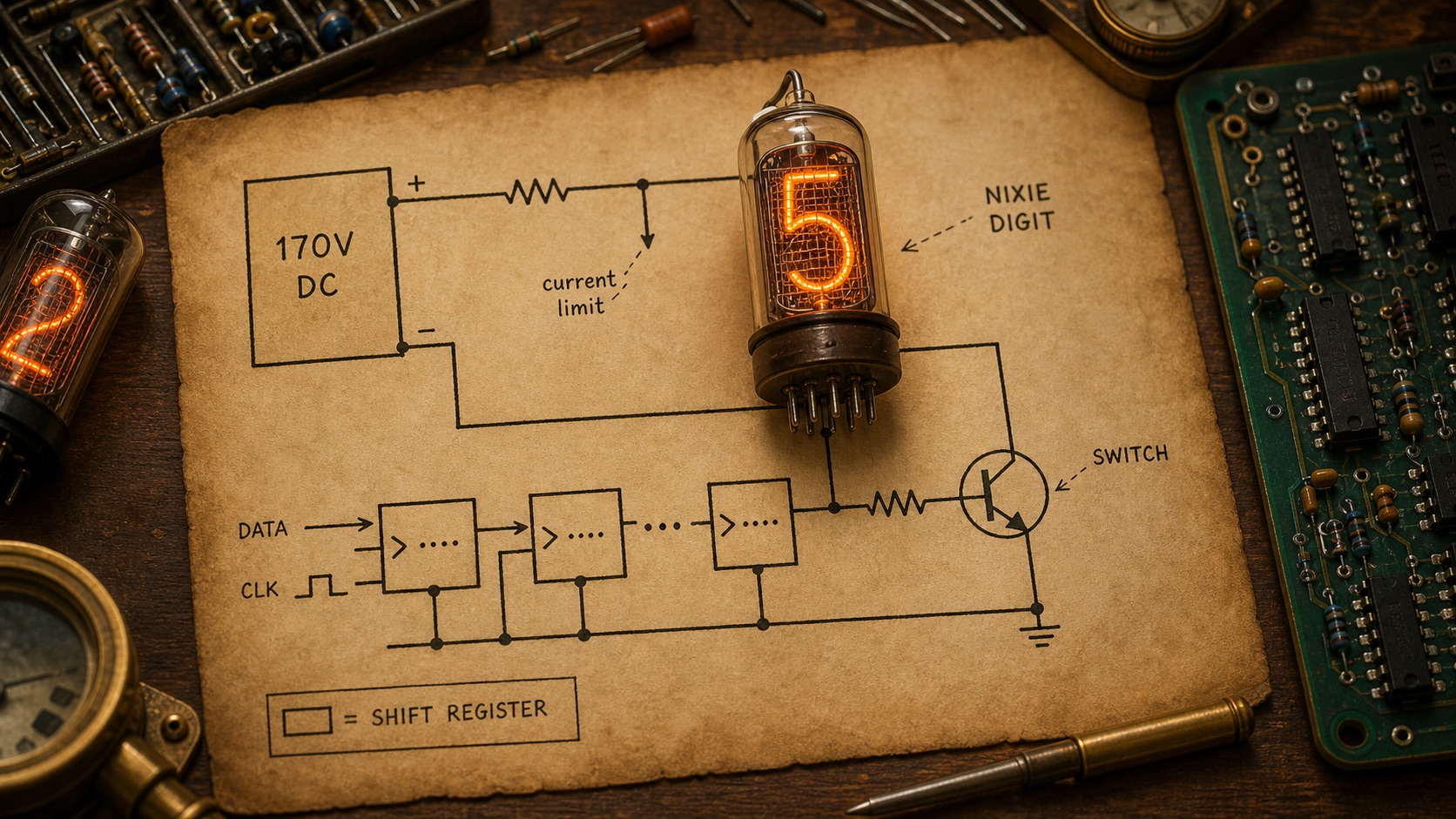
Original generated reference image showing a simplified high-voltage Nixie driver concept with supply, resistor, switch, and shift-register blocks
Original generated driver concept. It is intentionally simplified: use data sheets and qualified electronics practice before building real high-voltage hardware.

Nixie drive

Lighting a digit is simple; making a safe clock is the hard part.

Start with the datasheet

The supply voltage, striking voltage, maintaining voltage, cathode current, and current-limiting resistor should come from the tube data sheet, not from guesswork.

Think 170 V DC as a common clock baseline

Many small and medium Nixie clocks use a high-voltage DC rail around 170 V. The current is limited so the tube glows without damaging the cathode.

Switch the cathode, not the glass

A clock selects one digit by pulling the chosen cathode into the circuit. Older demonstrations can use a rotary switch; practical clocks use transistor or driver IC stages.

Multiplexing is a trade-off

Scanning can reduce hardware, but it changes brightness, flicker behavior, and camera banding. Static drive is simpler to photograph and often preferred for premium real-tube clocks.

Aging and care

Nixie failures are usually mechanical, chemical, or drive-current problems.

The practical ownership lesson is conservative current, digit cycling, safe enclosure design, and careful handling. Old tubes are beautiful because they are physical, and that also makes them finite.

Cracked glass or slow leaks change the gas environment and prevent stable glow discharge.

Sputtered metal can darken the inside of the envelope and reduce display contrast.

Cathode poisoning leaves weak or patchy digits when the same numbers are used too often.

Loose internal supports or bent cathodes can create shorts, dead digits, or uneven glow.

VFD branch

VFD is not blue Nixie. It is a different tube technology with its own logic.

Vacuum, filament, grid, phosphor

A VFD is closer to a small display tube than to a neon indicator. A heated filament emits electrons, a grid shapes the flow, and phosphor-coated anodes make the blue-green display.

Lower voltage, more display logic

VFD clocks do not need a Nixie-style 170 V rail, but they do need filament power plus grid and anode drive. Multi-character VFD modules are often designed for dynamic scanning.

Long life, different aging

VFDs avoid Nixie cathode poisoning, but phosphor fatigue, filament aging, getter condition, glass damage, and vibration can still end the usable life of a display.

The color is chemistry

The familiar cyan-green comes from phosphor composition. Other VFD colors exist, but the blue-green instrument-panel look is the reason collectors treat VFD as its own branch.

Practical buying matrix

IPS is the modern mainstream answer, not the museum answer.

QuestionReal NixieVFDIPS Nixie-style
What is glowing?Ionized neon around shaped cathodesPhosphor struck by emitted electronsMiniature IPS panels
Best reason to buyAuthentic artifact and depthBlue-green instrument-panel moodDaily ownership, dial packs, low voltage
Main riskTube scarcity and high-voltage electronicsModule availability and uneven agingBad simulations and dishonest listings
Best buyerCollector, photographer, electronics romanticAudio-shelf and calculator-era enthusiastMost modern desk owners

The practical conclusion.

Real Nixie is the object to collect, VFD is the display to appreciate, IPS is the format most people should actually buy, and LED matrix is the playful branch. The best clock is not the most authentic one; it is the one whose trade-offs match the room. For purchase recommendations, use the buyer guide index.

Source trail: see the Computer History Museum Nixie entry, Noritake Itron history, and IEEE Milestone note on VFD development, and Omnixie's longer technical reference notes on Nixie tube clock technology and Nixie tube types.